Free PDF Ecotourism and Sustainable Development, Second Edition: Who Owns Paradise?, by Dr. Martha Honey PhD
Tips in picking the very best book Ecotourism And Sustainable Development, Second Edition: Who Owns Paradise?, By Dr. Martha Honey PhD to read this day can be obtained by reading this page. You can discover the best book Ecotourism And Sustainable Development, Second Edition: Who Owns Paradise?, By Dr. Martha Honey PhD that is marketed in this world. Not only had actually the books published from this nation, but also the various other countries. And also now, we intend you to review Ecotourism And Sustainable Development, Second Edition: Who Owns Paradise?, By Dr. Martha Honey PhD as one of the reading materials. This is just one of the most effective publications to collect in this site. Consider the resource and also search guides Ecotourism And Sustainable Development, Second Edition: Who Owns Paradise?, By Dr. Martha Honey PhD You can discover lots of titles of the books offered.
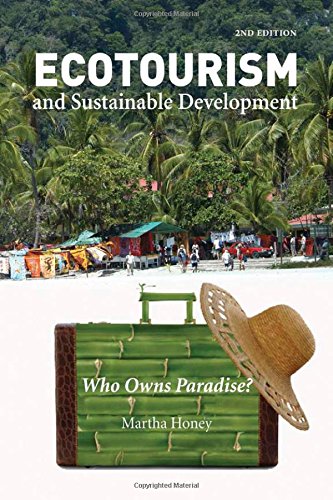
Ecotourism and Sustainable Development, Second Edition: Who Owns Paradise?, by Dr. Martha Honey PhD

Free PDF Ecotourism and Sustainable Development, Second Edition: Who Owns Paradise?, by Dr. Martha Honey PhD
Ecotourism And Sustainable Development, Second Edition: Who Owns Paradise?, By Dr. Martha Honey PhD. Reviewing makes you a lot better. Who states? Several wise words state that by reading, your life will certainly be a lot better. Do you believe it? Yeah, show it. If you require guide Ecotourism And Sustainable Development, Second Edition: Who Owns Paradise?, By Dr. Martha Honey PhD to read to show the smart words, you could see this web page flawlessly. This is the site that will certainly offer all the books that possibly you need. Are guide's collections that will make you really feel interested to read? One of them right here is the Ecotourism And Sustainable Development, Second Edition: Who Owns Paradise?, By Dr. Martha Honey PhD that we will certainly propose.
As understood, journey and experience about driving lesson, enjoyment, and also understanding can be gotten by just reading a publication Ecotourism And Sustainable Development, Second Edition: Who Owns Paradise?, By Dr. Martha Honey PhD Even it is not straight done, you could know more concerning this life, about the world. We provide you this appropriate and also easy means to get those all. We offer Ecotourism And Sustainable Development, Second Edition: Who Owns Paradise?, By Dr. Martha Honey PhD and many book collections from fictions to science at all. Among them is this Ecotourism And Sustainable Development, Second Edition: Who Owns Paradise?, By Dr. Martha Honey PhD that can be your companion.
What should you assume much more? Time to get this Ecotourism And Sustainable Development, Second Edition: Who Owns Paradise?, By Dr. Martha Honey PhD It is very easy then. You can just rest and stay in your area to obtain this book Ecotourism And Sustainable Development, Second Edition: Who Owns Paradise?, By Dr. Martha Honey PhD Why? It is online book shop that offer numerous collections of the referred books. So, simply with internet link, you can enjoy downloading this publication Ecotourism And Sustainable Development, Second Edition: Who Owns Paradise?, By Dr. Martha Honey PhD and numbers of books that are looked for currently. By checking out the web link web page download that we have actually given, guide Ecotourism And Sustainable Development, Second Edition: Who Owns Paradise?, By Dr. Martha Honey PhD that you refer a lot can be discovered. Just save the asked for book downloaded and install and after that you can enjoy guide to read each time and location you want.
It is quite simple to check out guide Ecotourism And Sustainable Development, Second Edition: Who Owns Paradise?, By Dr. Martha Honey PhD in soft documents in your gadget or computer system. Again, why ought to be so hard to obtain the book Ecotourism And Sustainable Development, Second Edition: Who Owns Paradise?, By Dr. Martha Honey PhD if you can select the less complicated one? This internet site will certainly alleviate you to choose and also decide on the best collective books from the most ideal vendor to the released publication just recently. It will constantly upgrade the compilations time to time. So, hook up to internet and visit this website constantly to obtain the new publication every day. Currently, this Ecotourism And Sustainable Development, Second Edition: Who Owns Paradise?, By Dr. Martha Honey PhD is yours.
Around the world, ecotourism has been hailed as a panacea: a way to fund conservation and scientific research, protect fragile ecosystems, benefit communities, promote development in poor countries, instill environmental awareness and a social conscience in the travel industry, satisfy and educate discriminating tourists, and, some claim, foster world peace. Although “green” travel is being aggressively marketed as a “win-win” solution for the Third World, the environment, the tourist, and the travel industry, the reality is far more complex, as Martha Honey reports in this extraordinarily enlightening book.
Ecotourism and Sustainable Development, originally published in 1998, was among the first books on the subject. For years it has defined the debate on ecotourism: Is it possible for developing nations to benefit economically from tourism while simultaneously helping to preserve pristine environments? This long-awaited second edition provides new answers to this vital question.
Ecotourism and Sustainable Development is the most comprehensive overview of worldwide ecotourism available today, showing how both the concept and the reality have evolved over more than twenty-five years. Here Honey revisits six nations she profiled in the first edition—the Galapagos Islands, Costa Rica, Tanzania, Zanzibar, Kenya, and South Africa—and adds a fascinating new chapter on the United States. She examines the growth of ecotourism within each country’s tourism strategy, its political system, and its changing economic policies. Her useful case studies highlight the economic and cultural impacts of expanding tourism on indigenous populations as well as on ecosystems.
Honey is not a “travel writer.” She is an award-winning journalist and reporter who lived in East Africa and Central America for nearly twenty years. Since writing the first edition of this book, she has led the International Ecotourism Society and founded a new center to lead the way to responsible ecotourism. Her experience and her expertise resonate throughout this beautifully written and highly informative book.
- Sales Rank: #195554 in Books
- Published on: 2008-08-04
- Ingredients: Example Ingredients
- Original language: English
- Number of items: 1
- Dimensions: 9.00" h x 1.30" w x 6.00" l, 1.65 pounds
- Binding: Paperback
- 568 pages
Review
"Honey's definition of ecotourism is ambitious."
(Planning)
"Highly acclaimed as the most comprehensive study of both the theory and practice of ecotourism...The new edition...marks a major rewrite of the original book."
(Responsible Travel and Tourism)
About the Author
Martha Honey is codirector of the Center on Ecotourism and Sustainable Development and editor of Ecotourism and Certification: Setting Standards in Practice (Island Press, 2002). Previously she worked as a freelance journalist in Latin America and Africa for The Washington Post, The New York Times, the Associated Press, ABC-TV, and the BBC. She has received numerous awards for her investigative journalism.
Most helpful customer reviews
15 of 17 people found the following review helpful.
Unfortunately the controversies and paradoxes continue. It's the economics that is missing!
By Emc2
I was really looking forward for this updated edition, since the previous one was published in 1999, when ecotourism was still in its infancy, and full of controversies and paradoxes. Undoubtedly this updated edition will continue to be a textbook in ecotourism courses and a key reference for scholars and practitioners, as well as of interest for travelers with a genuine interest in ecotourism by its purist definition. This second edition recounts how ecotourism went from childhood to adulthood, and unfortunately, the contradictions and paradoxes still remain.
In this edition Mrs. Honey revisits six of the seven countries profiled in the first one, the chapter on Cuba was deleted. As explained by the author, Cuba has followed a more classic Caribbean-style resort tourism rather than ecotourism, and in substitution, a new chapter on ecotourism in the US was included. Part 1 of the book presents a comprehensive overview of both the international tourism industry today, and ecotourism in particular, including new materials on certification programs and the role and support of multilateral aid institutions, such as the World Bank, IDB and USAID. Also this edition presents the latest developments regarding traveler's philanthropy and voluntarism, as part of a new trend regarding corporate social responsibility initiatives within the tourism industry led by ecotourism companies.
After going through the evidence presented in the country cases, and the excellent discussion regarding the paradoxes of ecotourism presented in the book Critical Issues in Ecotourism: understanding a complex tourism phenomenon, I was not only disappointed by the lack of evolution of the field, but also realized that the origin of the never ending contradictions and paradoxes can be found in the definition of ecotourism, which disregards the most basics principles of economics, despite the fact of being advocated as a means for sustainable economic development. The law of supply and demand is as inexorable as Newton's Law of Gravity, it works everywhere, and cannot be repealed, whether you believe in it or not. The principles behind the definition of ecotourism are based on several ideological postulates reflecting the proponent's idealistic view of the world rather than on the basis of a market segment within the tourism industry, which must considers consumer choices and preferences, price signals, externalities, economies of scale, market failures, and basic business principles such as financing and production chains.
The problem is that the whole concept of ecotourism was developed exclusively from the point of view of conservationists and environmentalists, who reject free markets, globalization, and all the other evils of capitalism. The following assertion, found in Chapter 3, leaves no doubts about the intentions of ecotourism proponents: "even as ecotourism was growing rapidly in the early 1990s, economic globalization, free trade, and privatization were proving to be strong countervailing forces to the philosophy and promise of ecotourism". One of the promises of ecotourism proponents is "that the portion of profits retained within the Third World will be substantially greater, and the environmental and social consequences will be far less, than with conventional tourism". Mrs. Honey openly asserts that globalization and free trade are "undermining the sustainability of smaller and locally owned ecotourism ventures in developing countries" as the `high concentration of new international firms in key sectors... creates market power and the potential for the abuse of dominance by large international firms". However, as documented in the book, the Tanzanian case demonstrates how foreign investment and globalization were indispensable to star up the tourism industry.
Because the definition of ecotourism is built on such moral high-grounds and in denial of market forces, the result could not be other than a divorce between pure ecotourism principles and economic and business realities. Unfortunately the number of altruist and philanthropic human beings is quite limited, thus, pure ecotourism as advocated by its proponents is rare, and not surprisingly, as reported in the book, several locales considered as islands of excellence in the first edition, today are in danger of disappearing just because of changes in ownership. Until market forces are recognized as an integral part of ecotourism activities, ecotourism will continue to be just as a market niche for a few conscientious travelers and conservationists, as according to figures presented in the book, after almost 30 years from its conception, ecotourism make up just between 5 to 13% of international visitors. Mrs. Honey blames ineffective or insufficient marketing as the probably the primary reason why worthy ecotourism ventures in developing countries failed to attract visitors. Or is it because in the free market gives consumers the power to choose? Tourism is demand driven, and clearly most international visitors are simply not interested in just educational travel as the ecotourism definition requires. As the evidence presented in the book shows, in reality there is a symbiosis between some forms of mass tourism and pure ecotourism, thus allowing pure ecotourism ventures to have financial feasibility, as they benefit from the spillover coming from mass tourism and the other activities.
Costa Rica is proof that several market segments can co-exist and grow together in a mutual beneficial symbiosis, from mass sun and beach to pure ecotourism, as a majority of international visitors end up visiting at least one national park. A similar example reported in the book is South Africa's Sun City, where gambling casinos are the magnet to attract masses of tourists, some of whom visit the nearby national park. However, Mrs. Honey repeats the same criticism she did ten years ago regarding Costa Rica's "risky two-track policy of heavily marketing its parks and ecotourism, while trying to increase visitor number by means of cruise tourism, prepaid air charter tours, large beach resorts, and urban hotels owned by international chains..." However, the statistics presented in the book show that 61% of visitors visited national parks, 66% observed flora and fauna and 77% went to the beach. This mix of products is precisely what makes Costa Rica an attractive destination and this is how it has been done for almost 25 years now, so I will call it a proven success, not a risky proposition. As recounted in the book, even real ecotourism operators and lodge/hotel owners report that international visitors increasingly demand more luxurious accommodations while their knowledge and interest in nature are increasingly casual.
Though a very desirable and noble objective, another principle of the ecotourism definition that does not match reality but instead seems wishful thinking is the assumption that ecotourism "strives to empower and benefit local residents and rural communities, meaning small-scale locally owned enterprises." Even Mrs. Honey recognizes that most communities are not up to the task, nor have access to the financial resources required for large tourism operation, assuming internal conflicts within the community are avoided. And as illustrated in several cases, conflict indeed arises, even among community members, which is unavoidable when money and profit is involved. The evidence presented in the book also shows that actually most small-enterprises and community owned businesses have problems for lack of know-how and business skills, financial resources and government support in carrying out proper marketing. In order to resolve this problem, some ecotourism scholars advocate for government intervention. However, the cases presented, mainly from Africa and the Galapagos, illustrate what a disaster government intervention has been in nature-based and ecotourism, whether due to corruption, unintended consequences, or institutional weakness. And as for government central planning, the disastrous social and economic failures of the former Soviet Union and China under Mao's regime are enough evidence that this is not an option.
Another criticism of Mrs. Honey analysis has to do with the expected community involvement. The Latin American and African contexts are completely different, not only for historical, political and cultural reasons, but mainly because most of the African parks were created under colonial rule by removing indigenous populations by force and without any compensation. Therefore, the principles of ecotourism do not fit the same in all regions, and this difference has to be taken into account.
The discussion of ecotourism in the US merits special attention by the fact that the author here applies a more relaxed definition of ecotourism which clearly does not fulfill all the principles associated with the concept, thus adding one more contradiction. The country case presents agritourism and eco-ranching as forms of pure ecotourism in the US. In the former case it includes wine tourism in Napa and Sonoma on the basis that these are family-owned wineries. The latter includes eco-lodges in cattle ranches at Wyoming, Montana, and Idaho. Why is this ecotourism? just because both are "efforts to preserve family-owned businesses and the land, local crops, cultural traditions, and ways of life from outside encroachment". Never mind that these are no longer pristine natural areas, but rather deforested cattle land and/or "sustainable" crop land, clearly showing that ideology comes before than consistency.
My last complain has to do with the chapter about Zanzibar which actually is just a critique of the mass tourism taken place in the island, as the discussion makes clear that the country only has a handful of real ecotourism hotels and projects. Therefore, instead of Zanzibar maybe some other more interesting country case could have been included, such as Brazil, the second largest recipient of international tourists in Latin America after Mexico (and not Costa Rica as wrongly reported in the book), or any of the Southeast Asian countries now trying to develop ecotourism.
Despite my criticism and Mrs. Honey's political bias, this edition contains very useful information for students, academics, and practitioners of ecotourism and tourism in general. And as for the controversies and paradoxes, these are not going to go away until a more realistic definition of ecotourism is introduced, coherent with basic principles of free market economics and the way businesses operate in the real world. For a detailed and comprehensive discussion on these controversies and paradoxes from the point of view of several schools of thought read Critical Issues in Ecotourism: understanding a complex tourism phenomenon.
1 of 1 people found the following review helpful.
Fantastic introduction to the topic
By Rui Pinto
I wanted to learn a bit more about tourism and came a cross this book. Affordable, easy to read and well structured, Honey's book provided much more than an introduction to ecotourism. It provides a glimpse into the industry, engages readers and provides them with a conceptual framework to critically assess certain industry claims. Fantastic book. I did not read all the case studies, but the ones I read were very interesting and showed different facets of ecotourism in different countries.
0 of 0 people found the following review helpful.
totally useless. No satisfaction from the distributor or publisher
By dan colgan
Cover of the book was attached upside down and backwards.
totally useless.
No satisfaction from the distributor or publisher.
Ecotourism and Sustainable Development, Second Edition: Who Owns Paradise?, by Dr. Martha Honey PhD PDF
Ecotourism and Sustainable Development, Second Edition: Who Owns Paradise?, by Dr. Martha Honey PhD EPub
Ecotourism and Sustainable Development, Second Edition: Who Owns Paradise?, by Dr. Martha Honey PhD Doc
Ecotourism and Sustainable Development, Second Edition: Who Owns Paradise?, by Dr. Martha Honey PhD iBooks
Ecotourism and Sustainable Development, Second Edition: Who Owns Paradise?, by Dr. Martha Honey PhD rtf
Ecotourism and Sustainable Development, Second Edition: Who Owns Paradise?, by Dr. Martha Honey PhD Mobipocket
Ecotourism and Sustainable Development, Second Edition: Who Owns Paradise?, by Dr. Martha Honey PhD Kindle
0 komentar:
Posting Komentar